For decades, the broadband gateway in our homes was a “dumb box.” Its one job was to connect us to the internet. Today, that box is undergoing the most significant transformation in its history. It’s becoming a sophisticated, service-defined edge compute platform. This shift isn’t a future-gazing prediction but a revolution happening right now, underpinned by the powerful combination of open source, open standards, and cloud-native management.
However, as exciting might be, this transformation brings immense complexity. How can service providers innovate at the speed of software, avoid vendor lock-in, and managemillions of multi-vendor devices deploying AI-driven applications?
The answer lies in disaggregation
Old models of monolithic, proprietary firmware is broken. It’s slow, expensive, and stiflesinnovation. The new model breaks this apart, and it’s built on two pillars, Open Standards and Open Source.
The Broadband Forum(BBF) has laid the foundation for this revolution with the User Services Platform (USP), or TR-369. This is the lingua franca for the modern connected device. It’s a data model and protocol that completely separates the services (like Wi-Fi management, cybersecurity, or AI insights) from the underlying hardware and firmware.
The adoption of USP isn’t a question of “if” but “when.” A landmark October 2025 “Future of the Connected Home” report from Omdia and the Broadband Forum found that 88% of respondents have already deployed or are planning to deploy USP within the next 18 months. We’re already seeing massive, real-world deployments, such as Incognito’s February 2025 announcement of managing over five million devices on a single North American operator’s 5G fixed-wireless USP deployment.
Beyond device management, the ability to run diverse, third-party applications securely at the edge requires another layer of open standards: containerization. This is where principles from the Open Container Initiative(OCI) and the Cloud Native Computing Foundation(CNCF) become paramount. OCI defines the specifications for container images and runtimes, ensuring that an application packaged as a container can run consistently across different environments. CNCF, through projects like Kubernetes (even if a full orchestrator isn’t always at the extreme edge), promotes cloud-native paradigms like immutable infrastructure, declarative APIs, and efficient lifecycle management for these applications. This standardization allows for a vibrant ecosystem of plug-and-play services at the broadband edge, based on real world standards, proven not only by Telco Industry but also Enterprise in various sectors!
However, while crucial, the spirit of open standards in the application space must be carefully balanced. The true value lies in standardizing the enabling infrastructure (like container formats and lifecycle APIs) and reusing proven, existing operating system interfaces without over-standardizing the applications themselves. Imposing overly prescriptive protocols on application logic risks limiting developer creativity and stifling the very innovation we aim to foster. For instance, leveraging established Linux kernel interfaces, including powerful tools like eBPF for high-performance networking and observability, or standard network protocols and system calls, allows developers to build sophisticated applications without needing bespoke, narrowly defined edge APIs. By focusing on fundamental, adaptable standards that expose these robust underlying capabilities, we ensure portability and interoperability while providing maximum freedom for dynamic service development.
While open standards provide the critical outlining and protocols, it’s open-source communities that build the robust, vendor-agnostic engines enabling innovation at the broadband edge. This is where organizations like the prpl Foundation and RDK-B play a pivotal role, translating standards into deployable, high-performance software. A standard is just a blueprint. You need a running engine.
The prpl Foundation is building the “carrier-grade OpenWrt” for the industry. It provides a common, stable, and secure open-source baseline, prplOS, that integrates key components like prplMesh for Wi-Fi and, crucially, prplLCM for managing the lifecycle of containerized applications. PrplOS and increasingly RDK-B are adopting this approach, leveraging OCI-compliant containers and CNCF-inspired lifecycle management (via prplLCM) to deliver flexible application environments.
The clear trend is a future with a few major open-source device platforms (prplOS and RDK-B), all centrally managed by the BBF TR-369/USP standard and uniformly capable of deploying highly portable, OCI-compliant containerized services to the broadband edge. This convergence allows operators to abstract away device specifics and focus on delivering services.
Intelligent Broadband: Bridging Edge Action and Cloud Power#
Why do all these advancements matter? Because they unlock the true value of the gateway, transforming it into an edge compute node. This enables a powerful hybrid AI model where the Cloud and the Edge work synergistically. While large-scale AI model training and complex analytics often reside in the Cloud, the Edge is where real-time inference, immediate action, and data pre-processing happen.
When you have a standards-based edge platform capable of running applications, you stop selling just “speed” and start delivering intelligent services powered by this hybrid approach. AI moves from a distant cloud concept to a tangible, responsive tool right inside the home. Running AI inference directly on the gateway (Edge AI) is critical for several reasons within this model:
Low Latency: For applications like real-time gaming optimization, instantaneous threat detection, or smart home responsiveness, the round-trip delay to a cloud server is unacceptable. Edge AI delivers decisions in milliseconds.
Data Privacy & Efficiency: The gateway sees all home internet traffic. Edge AI can process sensitive data locally for services like advanced parental controls without exporting private browsing habits. It can also filter, anonymize, or aggregate data before potentially sending smaller, relevant insights back to the cloud for further analysis or model retraining, optimizing bandwidth usage.
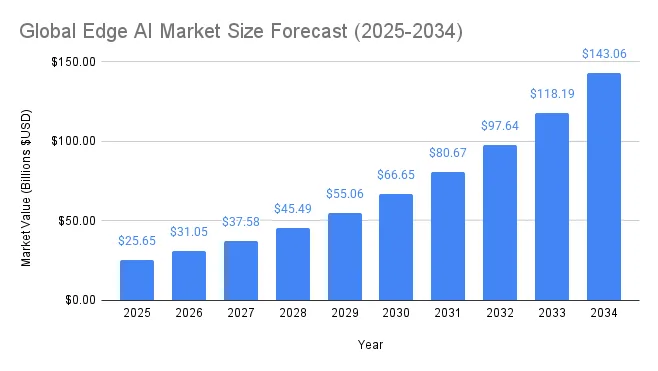
This hybrid Edge-Cloud AI approach represents the new frontier of value in broadband. The data underscores its significance:
A Massive Market:Precedence Research(September 2025) forecasts the global edge AI market growing from over $21 billion in 2024 to $31 billion in 2026 and more than $143 billion by 2034.
A Fundamental Network Shift:Dell’Oro Group(January 2025) noted that “broadband access networks are evolving into large-scale edge compute platforms,” with spending on traditional hardware and software now being “supplemented by” spending on AI and machine learning tools.
Urgent Operator Demand: The same October 2025Omdia/BBF report confirms this: 97% of respondents deem AI-powered features “important” for the connected home. Both figures come from a survey of 116 providers, published by the Broadband Forum and sponsored by vendors in the space.
Source: Precedence Research, September 2025.
Ultimately, the future of broadband is shifting focus from the physical gateway itself to the services and experiences it enables. This future thrives on openness, standardization, and intelligent, service-defined platforms that empower operators to innovate and meet evolving customer needs.
Written in October 2025. The argument about fleets as a defensible position is developed further in The Slice Underneath the AI Layer, and the case for autonomy rather than latency as the reason to put inference on the device in AI on Edge: Autonomy.